
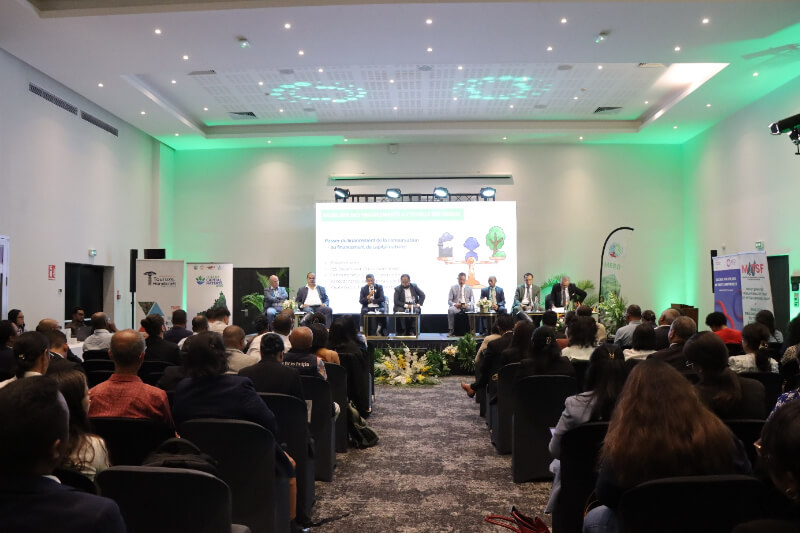
On 2 and 3 April 2026, the 3rd edition of the Natural Capital Forum was held in Antananarivo, bringing together representatives from the government, the private sector, financial institutions, technical and financial partners, the academic world and civil society organisations.
Organised under the auspices of the Ministry of the Environment and Sustainable Development (MEDD) and led by the Natural Capital Madagascar Network, the Forum reaffirms a shared ambition: to make natural capital a strategic pillar of Madagascar’s sustainable development.
Natural capital: a prerequisite for national sovereignty and stability
The discussions highlighted a fundamental reality: in a country such as Madagascar, the preservation of ecosystems is not merely an environmental choice, but a prerequisite for economic security, social stability and national sovereignty.
For too long, economic development and natural capital have been seen as mutually exclusive. Yet, in the case of Madagascar, this view constitutes a strategic error. Without secure water supplies, functional soils, forests to regulate catchment areas and resilient ecosystems, there can be no competitive agriculture, no reliable energy and no sustainable attractiveness for investment.
Protecting natural capital is not an ecological luxury. It is a prerequisite for economic security, social stability and national sovereignty.
A collective responsibility to shift economic trade-offs
At the Forum, the Executive Director of FAPBM, Dr Rija Ranaivoarison, provided a structured response to the Forum’s central question: the role of the various stakeholders in shifting economic trade-offs in favour of water security and ecosystem services.
“I believe that everyone has a different but complementary responsibility. The state must set the rules of the game, make long-term decisions and ensure coherence between water, mining, forestry and land-use planning. The private sector must move towards value-creation models that incorporate the true cost of ecological degradation. Financial institutions must redirect flows towards investments that protect water, restore landscapes and reduce risks. And conservation stakeholders must provide the data, the economic evidence, the mechanisms and the long-term vision.”
The real challenge is to ensure that water security and ecosystem services are not seen as constraints, but as strategic assets for growth and resilience.



Reforming economic incentives to correct market signals
The Forum highlighted that many processes of environmental degradation remain economically rational due to distorted economic signals.
The aim is to realign economic incentives to stop indirectly financing the degradation of natural capital. Today, practices such as charcoal production, agricultural deforestation and water overexploitation remain economically attractive.
This requires three levers:
- phasing out inefficient incentive mechanisms
- introducing positive incentives (agroecology, reforestation, water efficiency)
- incorporating a form of ‘true pricing’ for natural capital
‘As long as degradation remains cheaper than preservation, we will continue to make the wrong trade-offs.’
Priority trade-off zones and large-scale restoration
The discussions also highlighted the need to make decision-making more locally focused.
Establishing a national system of “priority trade-off zones” involves identifying the areas where trade-offs are most critical (water, mining, agriculture, conservation) and applying specific rules in those areas.
These zones correspond in particular to catchment areas, ecological corridors and mining areas, where conflicts over land use are most acute.
This entails:
- a national mapping of high-conflict zones
- specific regimes (restrictions, compensation, targeted investments)
Within this framework, the country must scale up landscape restoration, but with an economic rationale:
- restoration integrated into value chains (sustainable wood energy, agroforestry, forest products)
- public-private partnerships
- blended finance
Restoration is not a cost, but a productive investment in the rural economy. It is not just a matter of managing nature better, but of repositioning natural capital as a central driver of development.
FAPBM: a key player in the sustainable financing of natural capital
As part of this initiative, Madagascar Protected Areas and Biodiversity Fund (FAPBM) has actively contributed to strategic discussions.
It reaffirms its vision: natural capital is a fundamental driver of sustainable development, and its protection is essential for economic stability, territorial resilience and national sovereignty.
The FAPBM therefore supports the strengthening of sustainable financing mechanisms capable of supporting large-scale investments in landscape restoration and ecosystem protection, whilst generating value for local communities.

From dialogue to collective action
Beyond simply taking stock, this third edition of the Forum signals a strong commitment to accelerating the transition from strategy to action.
The recommendations call for the recognition of natural capital as a strategic sovereign asset, the strengthening of integrated governance, and the deployment of a financial framework tailored to sustainable investment.
A new path is emerging: that of a development model in which Madagascar’s ecological wealth becomes a central driver of growth, resilience and opportunities for future generations.
In this context, stakeholders are calling for stronger partnerships between the state, the private sector, financial institutions and conservation organisations to accelerate investments that generate ecological, economic and social benefits.
FAPBM reaffirms its commitment to supporting this transformation and contributing to a future where biodiversity conservation and national development advance hand in hand.